Mental health help in Australia is a joke

GPs struggle in a system ill-equipped to deal with mental health

I sat in the waiting room staring at my hands, willing them to stop shaking. Anxiety was a fighter jet, roaring through my cells, dropping grenades from head to toe.

When the doctor called my name I shuffled after her, a shrunken version of a self I no longer recognised. Fixing her eyes on a computer screen, she hammered the keys and asked me to explain why I was there.

Our complex emotional pain is being treated with six-minute medicine by time-poor GPs, says Jill Stark.

Photo: Christopher Nielsen

When I told her I was experiencing what felt like an acute recurrence of the depression and anxiety I’d grappled with since I was a teenager she pushed a sheet of paper across the desk and I began to tick boxes.

During the last 30 days, how often did you feel hopeless? … During the last 30 days, how often did you feel so nervous that nothing could calm you down? … How often did you feel so sad nothing could cheer you up?

Ten questions, scored from one to five, with one being ‘none of the time’ and five ‘all of the time’. Under 20 is well. Over 30 is a severe mental-health disorder.

“You got 25, which means you’re only mild to moderately depressed, so there’s not much to worry about,” she said, reaching for the prescription pad before asking if I was suicidal.

I thought about it for a while and said no. “Good. These ones aren’t prescribed very often these days because they’re much easier to overdose on. But you’re not suicidal, so that’s fine.”

Less than fifteen minutes after I sat down I stood on the street weeping. I had no support, no plan for how I was going to make it through the day, armed only with the knowledge that should I want my kill myself the drugs I’d been prescribed were well-equipped for the job.

Journalist Jill Stark.

I wish this was an isolated experience. But since documenting my mental health battles in my recent memoir Happy Never After, I’ve been inundated with messages from people across Australia telling similar stories.

Our complex emotional pain is being treated with six-minute medicine by time-poor GPs struggling to meet demand in a system woefully ill-equipped to deal with the mental health challenges of modern life.

It was revealed in recent days that GP waiting rooms are crammed full of patients with psychological problems.

Research released by the Royal Australian College of General Practitioners found that 62 per cent of people visiting a doctor are presenting with mental health problems – significantly more than any other medical condition.

College president-elect Dr Harry Nespolon said doctors are in an impossible situation, forced to either charge patients for more time to manage these complex problems or wear the out-of-pocket costs themselves.

“As access to psychologists and psychiatrists can be restrictive, to say the least, GPs must not only work as the frontline of support – but as the entire support model, something which is currently not supported by patient Medicare rebates,” he said.

How much longer can we continue like this? When will we stop treating emotional health as the poor cousin to physical health?

We are in the grip of a mental health crisis. We have the highest Australian youth suicide rate in a decade. More people are depressed, anxious and medicated than at any other time in our history. If trends continue, clinical depression will be the second most disabling condition behind heart disease by 2020.

Raising awareness is not enough. The time for wristbands and hashtags has passed. We have learned to ask R U OK but when the answer is ‘no’, too often there is nowhere to go.

Our Medicare system needs to better reflect the times we live in and the health problems we face. Doctors need the financial support to offer longer consultations for patients with complex psychological needs.

And as a matter of urgency, we must stop rationing psychological services to ten subsidised sessions per year.

When I was at my lowest point, I saw my psychologist twice week just to keep my head above water. I raced through my Medicare sessions in five weeks.

At almost $200 per hour, I then had to raise almost $400 a week just to stay in therapy and out of hospital.

There are few other areas of healthcare where we place such arbitrary limits on a patient’s ability to recover.

Through life’s lottery I was fortunate enough to have a supportive employer, and family who could afford to fund my therapy. Without their assistance I honestly don’t think I’d be alive.

Not everyone is so lucky. Many people are no longer here because they couldn’t afford their mental illness. It’s a devastating indictment on a system that is fundamentally broken.

We must demand better. The chances of surviving our emotional pain should not be determined by the balance of our bank accounts.

Lifeline: 13 11 14

Jill Stark is a Melbourne journalist and author of Happy Never After

(c) Fairfax Media Australia.

Don’t expect to fly on the A380 with Qantas SYD-LAX – it can’t do it!

Qantas: Engine Problems Mean Its A380s Can’t Fly to the U.S. Big Problem.

You’d think that the Qantas A380 saga would be winding down by now, but you’d be wrong. Qantas is still struggling with the fact that it can’t operate the A380 to the U.S. because the engines simply can’t handle it. This means that things continue to get worse for engine-maker Rolls-Royce, and I imagine legal bills have only started to pile on. Rolls needs to get this thing under control, because right now Qantas is in a bad place.While Singapore and Lufthansa both use the Rolls-Royce Trent 970, Qantas had to use the 972 to get 2,000 pounds more thrust for its operation. There actually isn’t much of a difference in the engines at all, but one is rated to give a little more power. For Qantas, that little bit extra is really important.

Qantas has re-started flights from Sydney to places like Singapore on the A380, because it doesn’t need full thrust to operate that route. However, the prize has always been flights to Los Angeles, and that’s a different story.

A380 engine

At nearly 7,500 miles, Qantas needs every bit of thrust to get off the ground at LAX with a full passenger load and a lot of fuel. And that full thrust requirement is apparently why Qantas is having bigger engine problems with this air plane than anyone else. Any time you use full thrust, you put more stress on the engine. Engines are supposed to handle that just fine, but not in this case.

Qantas has now found that it can operate no more than 75 flights at top thrust before it needs to replace an engine. That’s ridiculous, considering each engine can cost $10 million or more. And it leaves Qantas with a huge problem.

Rolls-Royce had suggested last month that Qantas operate the engines with less thrust. That suggestion is completely worthless since it would mean Qantas could carry a mere 80 passengers on the LA to Sydney route. The airline might as well just operate a 747 at full capacity for a lot less cost with a lot more passengers. If it can’t carry a full load on the A380, that air plane is worthless.

The funny thing is that Qantas didn’t even want the more powerful engines in the first place. It opted for the same ones as Lufthansa and Singapore originally, but then Airbus announced the A380 would weigh 5 tons more than planned. That pushed Qantas to order the higher-thrust engines in order to make the air plane viable on the LA route.

So now Qantas is stuck between a rock and a hard place. It has A380s on the property but it can’t fly them where it wants without needing a multi million dollar engine change every few months. Rolls-Royce is going to have to fix this problem or Qantas is going to have to find an alternative.

Nancy-Bird and Minister Anthony Albanese

(Picture) Nancy Bird Walton – the first aviatrix in Australia. Qantas named their first A380 in her honour

The silver lining for Qantas is that it’s not going to be responsible for any of the cost here. Rolls-Royce and Airbus (to a lesser extent, if any), however, are going to have to open up those wallets. For Qantas, however, it would much rather just have an air plane that functions properly. Instead, Qantas now has to go through its peak travel season without the ability to use the A380 to the U.S.

© 2010 CBS Interactive Inc.. All Rights Reserved.

Cancer, sex and intimacy: Patients call for honest heads-up about impact of treatment

 Annie Gaffney and Kylie Bartholomew ABC Australia

Lynne Essex was diagnosed with endometrial cancer when she was 54. It has been three years since her treatment, but she still has not had sex.

“No-one told me anything about what would happen, how sensitive the area would be where I had the radiation,” she said.

“Because it was endometrial, the vaginal area is all very sensitive, and that’s what scares me about having sexual relations.

“I haven’t been in a partnership for about seven years.”

Ms Essex had a hysterectomy, but a few months later the radiation that was used to shrink another tumour tore a hole in her bowel, leaving her with an ileostomy bag.

Despite her terminal prognosis, she is determined to embrace life and dating opportunities.

But she said that journey had been made more difficult because she was not informed by doctors about the impact of cancer treatment on her sex life, and instead had to resort to her own research, and support service Bloomhill Cancer Care.

While Ms Essex has had “a couple of chances” at having an intimate experience over the past few years, she has been too scared.

“The fear has been there to actually go all the way,” she said.

Media player: “Space” to play, “M” to mute, “left” and “right” to seek.

“My bones have gone like osteoporosis now and I’ve had fractures in my pelvis, pubic bone and sacrum because of it.

“I think my situation [wearing an ileostomy bag] was I just wanted to hide it.”

Therapist calls for more sex talk

Ms Essex’s story is not surprising to sexologist Jocelyn Klug.

“I’m always hearing of patients who have not been informed of the consequences of treatment on their sexuality,” she said.

“For many doctors there’s an awkwardness. They don’t want to be seen to be prying and I think this is generally about their respect for the patients.”

Ms Klug urged patients to speak up to their partner and doctor.

“Most couples struggle to talk openly about sex and so when we don’t communicate, we’re left making assumptions,” she said.

“Find the courage to bring up this topic [to your doctor] and ask ‘What is the impact on my sex life?'”

She said far too many couples ended up avoiding sex and intimacy post-treatment.

“Sadly for a lot of people, because of sexual dysfunction following cancer treatment they … feel that being able to be sexually intimate with a partner is far too challenging.”

‘I’m just so self-conscious about having to poo all the time’

David (not his real name), a 36-year-old husband and father of two, was diagnosed with rectal cancer last year.

The tumour was located about 10 centimetres inside his rectum close to lymph nodes, bladder, bowel and the parts of his anatomy that affect erectile function.

But unlike Ms Essex’s experience, David was given detailed information from his doctor about the impact of surgery and treatment on his sexual function and overall health.

“I was told to bring my will in and make sure my affairs were in order,” he said.

“He [the doctor] couldn’t tell me if I was ever going be able to wee again properly or if I’d get any function back at all sexually.

“They said after six months if it’s not doing anything, it’s probably not going to do anything. It was devastating.”

Surgery was successful for David and his erectile function returned after a few months, but a brief stint wearing an ileostomy bag affected his confidence.

“Having a shit bag as I called it was pretty awful, and I felt pretty unattractive,” he said.

Eventually, David had the stoma reversed but that has left the young dad feeling anything but back to normal, because without a rectum he has limited bowel function and still soils himself. A lot.

“Once the stoma was closed, I was doing a poo up to 40 times a day,” he said.

“Trying to be intimate with that going on, it’s not happening.

“If I think we might be getting jiggy with it, I’d have to prepare by lunchtime that day … to prepare what I eat and then I don’t eat or make sure that I’ve had a shower because I’m just so self-conscious about having to poo all the time. It’s all awful.”

David continues to have ongoing support from his psychologist, psychiatrist and doctor.

“All my treating team and my nurse at Bloomhill, they all quite regularly bring it up [his sex life] as a major factor to consider,” he said.

Lynne’s story ‘not unique’, professor says

University of Sydney professor of medical oncology Fran Boyle said experiences such as Ms Essex’s were not unique, but the urgency of treatment could be one factor that prevented doctors from having a conversation with their patient about the impact of treatment on their sex life.

“I think there are probably situations where cancer treatment happens suddenly,” she said.

“Decisions need to be made very quickly and they are often life and death decisions with really quite complex decision-making and trade-offs.

“We know that under time pressure things that are difficult to talk about, and sex is one of them for many people, is often the thing that is going to get left out.”

Professor Boyle believed there could be greater scope for surgeons to raise the topic with patients, and called for compulsory communication training for them to facilitate that conversation.

She said there was likely to be an improvement in the medical fraternity in the future, with some changes underway within the Clinical Oncology Society of Australia.

“That will include things like monitoring bone health, emotional concerns and sexual health as well, so I think you’ll see an improvement in that area going forward, and we’d love to work with anyone who has access to patients to make that happen,” she said.

Courtesy Australian Broadcasting Corpration Australia.

Media power: why the full story of Murdoch, Stokes and the Liberal leadership spill needs to be told

Author

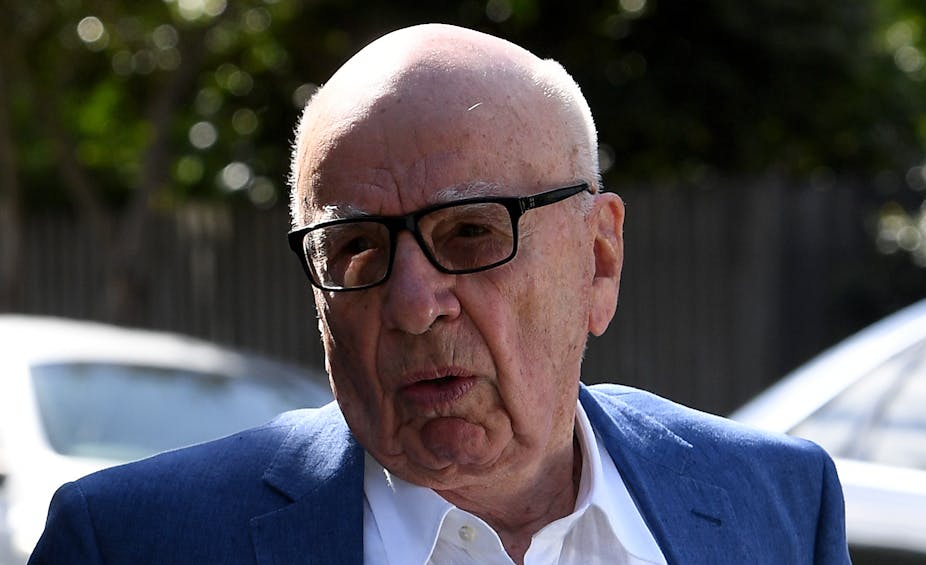
Media mogul Rupert Murdoch is notorious for meddling in politics. AAP/Dan Himbrechts

The first German chancellor, Otto von Bismarck, said there were two sights the public should not see: the making of laws and the making of sausages. To this list of enduringly nauseating spectacles we should add one more: the political machinations of media moguls.

ABC political editor Andrew Probyn has skilfully violated this standard of public taste by laying out what look like very plausible entrails of the evident involvement of Rupert Murdoch and Kerry Stokes in the recent Liberal Party leadership spill.


It is impossible to independently verify Probyn’s account because he has been careful to mask his sources. But it is plausible partly because some elements are corroborated by separate reports in the Australian Financial Review and Sydney Morning Herald, partly because Probyn worked for both Murdoch and Stokes for lengthy periods and may be assumed to have good contacts in those places, and partly because there is circumstantial evidence to support some of what he says.

The Australian reports that Stokes has denied having communicated with Murdoch over Turnbull’s leadership. Interestingly, however, the newspaper does not quote its own proprietor on the matter, which is the obvious way to corroborate Stokes’s claim.

Murdoch, of course, is notorious for meddling in politics. In Australia, it can be traced back to his endorsement of Gough Whitlam at the 1972 election, his campaign against Whitlam in 1975, which was so virulent even his own journalists held a strike in protest, his support for John Howard in 1996, his somewhat ambivalent support for Kevin Rudd in 2007 and his full-frontal support for Tony Abbott in 2013.

Front page of the The Sun newspaper, April 11 1992. Wikicommons

These campaigns were all in support of the winning side, and much the same has been true of his equivalent campaigns in the UK and the US. After John Major led the British Conservative Party to victory in 1992, Murdoch’s London Sun newspaper proclaimed in a front-page banner headline: “It’s the Sun wot won it”.

All this has created a perception of Murdoch as political kingmaker, a perception that frightens the life out of politicians and thus confers great power on Murdoch.

But as two Australian scholars, Rodney Tiffen and David McKnight, have persuasively argued in their separate studies of Murdoch, while his media outlets routinely shred and humiliate their political targets, the evidence is that Murdoch observes which way the wind is blowing and then finds a rationale for endorsing the likely winner.

The Economist’s Bagehot column was on to this 15 years ago, as Tiffen records. Referring to the London Sun’s boasting of its political power, the column observed:

[T]hat probably says more about Mr Murdoch’s readiness to jump ship at the right time than about the Sun’s ability to influence the votes of its readers.

Even so, perceptions can swiftly harden into political reality.

According to Probyn, when Murdoch was seen to turn against Turnbull over the past couple of months, the alarm went off in the prime minister’s office.

This is where Stokes, chairman of Seven West Media, is said to have entered the picture.

He is a friend of Turnbull’s and they are said to have discussed the apparent campaign by the Murdoch media to oust the prime minister.

Stokes and Murdoch have a chequered history, to put it mildly. They have fought long, bitter and costly legal battles, but as Margaret Simons says in her biography of Stokes:

In the cosy club of media, neither love nor hate lasts forever. The only constants are power, money and self-interest.

So, according to accounts by Probyn and the Financial Review, Stokes rang Murdoch to ask what was going on and Murdoch is said to have told him: “Malcolm has got to go.”

But on the question of who should replace him, the moguls were all over the shop.

Murdoch’s Daily Telegraph was touting Peter Dutton. Three days later, when Turnbull spilled the leadership positions, Dutton nominated, lost, but lit the fuse for the ultimate detonation of the Turnbull prime ministership.

Stokes was opposed to Dutton for complex reasons, but didn’t seem to know who to go for instead. On the day before the leadership spill, his newspaper, The West Australian, was promoting Scott Morrison. The next day it was promoting Julie Bishop, a West Australian.

This shambolic confusion among the moguls is comforting in a perverse kind of way, because in the end neither of them was able to dictate the outcome.

Murdoch achieved one objective – the ousting of Turnbull – but Dutton, his preferred pick to replace him, is now clinging to political life by a single vote in the House of Representatives thanks to the hovering spectre of the Constitution’s section 44 (v), not to mention trouble with au pairs.

Stokes? Well, he is new to this kingmaking caper. He clearly did not want his friend Turnbull out, but when that became inevitable, he didn’t know where to turn. As my old editor at The Age, Creighton Burns, was fond of saying, he was caught between a shit and a shiver.

The net effect of their efforts has been to bring the Liberal-National government to the brink of disintegration within months of a general election.

This time, Murdoch may have indeed created a winner – Labor leader Bill Shorten – not by the traditional means of showering support on him, but by destroying his opponents, even though they happen to be Murdoch’s own ideological allies.

It is the latest chapter in a long and discreditable history of media proprietors using their power to advance their political ends, usually for commercial rather than ideological purposes.

Sir Frank and Kerry Packer did it; so did successive generations of Fairfaxes. In 1961 the Fairfaxes went so far as to virtually run Arthur Calwell’s campaign out of the company’s executive offices on the 14th floor of its newspaper mausoleum in Sydney’s Broadway. The Sydney Morning Herald’s journalists renamed it the Labor ward in honour of the exercise.

In Britain, the mould for the politically meddling modern newspaper proprietor was set by Alfred Harmsworth (Lord Northcliffe) in the early 20th century.

He and the other mighty British press baron of the time, Max Aitken (Lord Beaverbrook), were the inspiration, if that is the word, for Rudyard Kipling’s celebrated condemnation:

[The press exercises] power without responsibility: the prerogative of the harlot throughout the ages.

So Probyn has done Australian democracy a service by exposing the entrails of what looks like another abuse of media power, even if it makes for a nauseating public spectacle.

It also raises serious questions about media accountability.

Australia has never had a publicly trusted or effective system of media accountability. All attempts to create one have been howled down, the loudest and crudest voices belonging to Murdoch’s lieutenants.


Read more: Australian media are playing a dangerous game using racism as currency


There is already a crisis in people’s faith in democratic institutions. A new report by the Australian Museum of Democracy and the University of Canberra shows only 41% of Australians are satisfied with the way democracy is working. That is a dramatic plunge from the 86% recorded in 2007.

In this climate of disenchantment, it is not surprising there are now calls for a public inquiry into the way Murdoch and Stokes have evidently played a manipulative role in changing the prime minister.


Honour their spirit. The Australian War Memorial.

In juts under over month from now the free world will remember the end of World War 1. A war that claimed 40 million military and civilians lives – let alone the trauma of those who came home wounded in body and mind. Since the end of WW1 100,000 military personnel have died in various conflicts overseas.

Remembrance Day has a special significance in 2018.

Sunday, 11 November 2018 marks the 100th anniversary of the Armistice which ended the First World War (1914–18).

Photograph taken by Steve Burton. PAIU2013/193.12

Tomb of the Unknown soldier Australian War Memorial AWM Canberra

One hundred years ago, on 11 November 1918, the guns of the Western Front fell silent after four years of continuous warfare. With their armies retreating and close to collapse, German leaders signed an Armistice, bringing to an end the First World War. From the summer of 1918, the five divisions of the Australian Corps had been at the forefront of the allied advance to victory. Beginning with their stunning success at the battle of Hamel in July, they helped to turn the tide of the war at Amiens in August, followed by the capture of Mont St Quentin and Pèronne, and the breaching of German defences at the Hindenburg Line in September. By early October the exhausted Australians were withdrawn from battle. They had achieved a fighting reputation out of proportion to their numbers, but victory had come at a heavy cost. They suffered almost 48,000 casualties during 1918, including more than 12,000 dead.

In the four years of the war more than 330,000 Australians had served overseas, and more than 60,000 of them had died. The social effects of these losses cast a long shadow over the postwar decades.

Each year on this day Australians observe one minute’s silence at 11am, in memory of those who died or suffered in all wars and armed conflicts.

Remembrance Day National Ceremony

10.30am – 12pm

The Remembrance Day National Ceremony includes a formal wreath laying, and Australia’s Federation Guard and the Band of the Royal Military College, Duntroon will be on parade.

For further enquiries please email: ceremony@awm.gov.au

Free tickets for the National Ceremony are available on line.

Remembrance Day Ceremony

For ticketing enquiries please email: ticketing@awm.gov.au

Remembrance Day breakfast

A breakfast event will be held in the Memorial’s Anzac Hall at 8am.
This sit down plated breakfast includes a presentation from Memorial Head of Military History, Ashley Ekins.

Breakfast


Last Post Ceremony

Each day the story of one of the fallen servicemen or women listed on the Roll of Honour is told at the Last Post Ceremony.

Traditionally on the 11th of November, the eulogy for the Unknown Australian Soldier is read. Remembrance Day 2018 will be the 25th anniversary of its first recitation by then Prime Minister the Honourable Paul Keating.

Dignitaries lay wreaths at the Stone of Remembrance, Remembrance Day 2014

Gallery Photographs from 11 November 1918

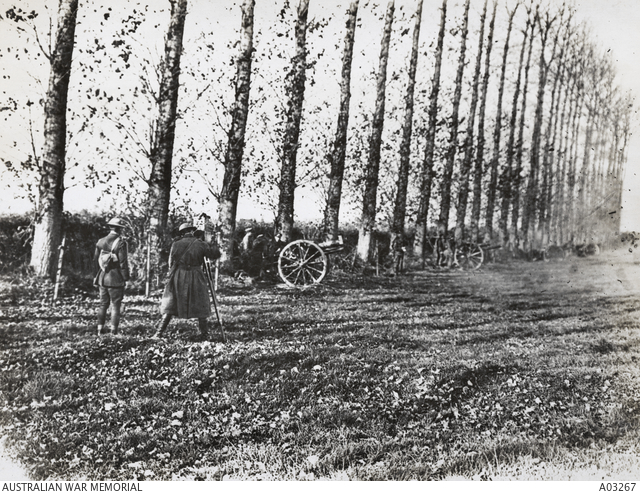
An unidentified cinematographer capturing the last shots to be fired before the armistice on 11 November 1918. Note the line of bare trees under which the guns are placed.

Sydney, NSW. 1918-11-11. Crowd in Martin Place celebrating the news of the signing of the armistice. This date was celebrated in later years as Remembrance Day

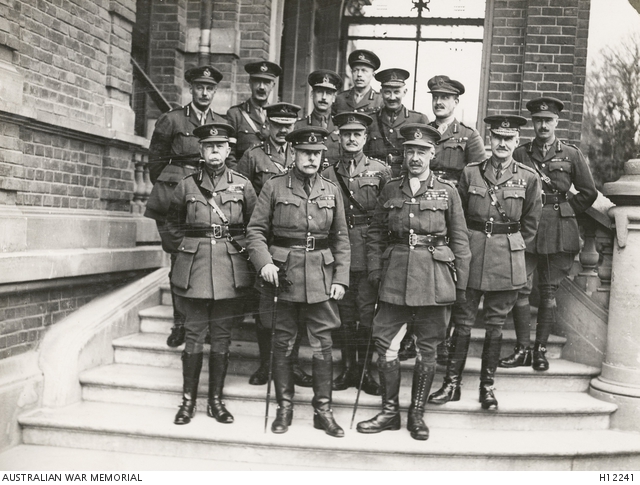
Cambrai, France. 11 November 1918. Field Marshal Sir Douglas Haig, centre front, with British Army commanders on Armistice Day. (Donor Imperial War Museum Q9690)

Adelaide, South Australia. 1918-11. A huge crowd at Parliament House for the Declaration of the Signing of the Armistice. (Donor W.S. Smith)

Story and images courtesy Australian War Memorial Canberra

Captain Cook’s HMS Endeavour might have been found in USA

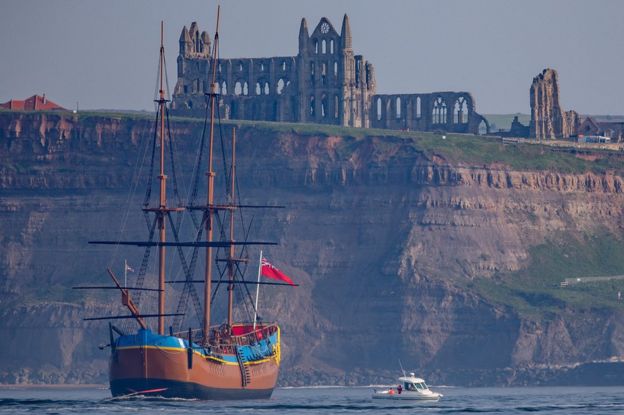
HM Bark Endeavour
Image copyright Science Photo Library
Image caption HMS Endeavour landed in Australia in 1770

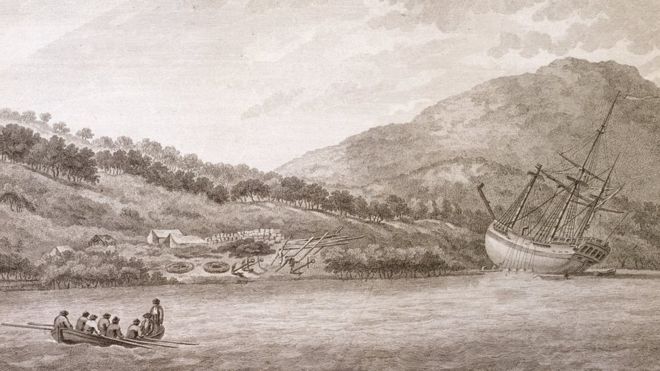
The hunt for the final resting place of Captain James Cook’s HMS Endeavour may soon be over – in time for the 250th anniversary of its voyage to Australia.

The Endeavour, then known as Lord Sandwich II, was sunk with 12 other ships off Rhode Island, in the US, in August 1778, but no-one was sure where.

Now, following a 25-year archaeological study of the area, the search has been narrowed to just “one or two” sites.

Experts are now hopeful it will be definitively identified by 2020.

That would be just in time for the anniversary of Capt Cook arriving in Australia, following a two-year voyage of discovery which initially set out from Plymouth, England.

The Rhode Island Marine Archaeology Project (Rimap), which has been working with the Australian National Maritime Museum (ANMM), said it would release a “3-D photogrammetric image of a promising site” on Friday.

But it will still be some time until the true identity of the wreck is revealed. “Detailed work” must be done during a planned excavation of the area, just off Goat Island, in 2019, it said in a statement.

“We’re not in a position to identify it conclusively,” Rimap’s Kathy Aththas told News.com.au.

“Once excavated it will require sampling, testing of the type of wood and nails, and analysis which won’t give us a definitive answer for another 18 months.”

Capt Cook set sail on Endeavour – a British-built coal ship – in 1768 on a scientific voyage to map the Pacific Ocean.

View of the Endeavour River Whole folio A view of the Endeavour River New Holland with the Endeavour laid on shore in order to repair the damage which she received on the rocks; June-July 1770.

It was the ship in which the explorer charted New Zealand and Australia between 1769 and 1771. He arrived off the south-east coast of what is now Australia in 1770, eventually making landfall at Botany Bay.

He later claimed the region for the British crown, despite the presence of large Indigenous communities.

After sailing back to Britain, the Endeavour was renamed Lord Sandwich II and became a troop carrier.

During the American War of Independence it was scuttled by the British Navy with the 12 other ships to form a blockade of the Narragansett Bay.

Australia’s elder abuse scandal ‘beyond belief’

  • Elder Abuse 1
Corey Lyle Lucas (left) pleaded guilty to assaulting elderly resident Clarence Hausler

On Sunday, Australia announced that it would hold a royal commission – its supreme form of inquiry – into the nation’s scandal-hit aged care sector. Prime Minister Scott Morrison warned Australians to brace for “bruising” evidence of abuse and negligence.

A hidden camera captures the chilling moment when an Australian care worker appears to try to suffocate an 89-year-old man with dementia. The image, first publicised in local news in 2016, highlighted the terror, domination and deceit of elder abuse in a country with an ageing population.

The mistreatment of Clarence Hausler in a nursing home in Adelaide in 2015 was uncovered by his daughter, who had been suspicious about her father’s bruises.

Video from a spy camera she secretly installed revealed that a care assistant, Corey Lyle Lucas, had apparently attempted to violently force-feed his bedridden patient who could not talk or walk, and pinned him down when he resisted. Lucas was convicted of aggravated assault. The care home apologised and said his actions were a “rogue act”.


‘Love is vanishing’

In recent years especially, Australia has been confronted with the exploitation of its youngest and oldest citizens. The nation is still digesting the recommendations of a royal commission that spent almost five years investigating the depraved treatment of children in institutions.

Now residential and in-home aged care will be scrutinised. In justifying the need for a royal commission, Mr Morrison said “our loved ones – some of them – have experienced some real mistreatment”.

“And I think that’s going to be tough for us all to deal with,” he added. “But you can’t walk past it.”

Image copyright Getty Images
Image caption The inquiry’s budget and start date are still to be decided

Community leaders say the true scale of elder abuse is unknown but anecdotal evidence has suggested it is a dark and deep-rooted problem.

“It is a scandal beyond belief,” says Reverend Bill Crews from Australia’s Uniting Church.

“How we can behave to one another – when we are not watched by others – is beyond belief. It started with young people. It is now with old people. We are a society where love is vanishing and the inevitable outcome of that is a lot of pain.”

An Elder Abuse Helpline was set up in New South Wales (NSW) in 2013, and state lawmakers have conducted their own investigation into the mistreatment of senior citizens.

“It is often psychological and emotional abuse but it can also be physical, financial and even sexual, which is extremely disturbing,” Tanya Davies, NSW minister for ageing, women and mental health told the BBC.

“As a nation we don’t yet have a comprehensive idea as to the length and breadth of this.”

Harrowing stories

Victims have also shared their stories with another inquiry in Western Australia.

A frail elderly woman, identified only as Sylvia, was forced to move into a nursing home after her son took her money to buy himself a house. According to a legal submission, Sylvia was scared that if she didn’t do as he asked, her son would assault her.

The inquiry was told that her son had threatened to burn down her home if she “called the cops” on him. To make his point, the son allegedly set fire to his bag in her living room. Sylvia was too afraid to take legal action and she died nine months after going into residential care.

Image copyright Getty Images
Image caption Quality of care in nursing homes will form part of the inquiry

Ian Henchske, chief advocate for independent lobby group National Seniors Australia, says a lot of elder abuse “takes place within the family”.

He told the BBC that less than 20% of elder abuse is reported to an authority, and that greed was mostly to blame.

“The predominant form of abuse that is being reported is financial abuse,” he says. “You have got a generation below the older generation looking at their parents and wondering when are they going to get out of that home because that is an important part of my inheritance.”

Ageism in society

Campaigners say that rapacious relatives suffer from “inheritance impatience” and that disrespect and abuse is underpinned by ageism.

“These sorts of things are similar to the attitudes and the discrimination that occurs around race and sexism,” says Jenny Blakey, the manager at Seniors Rights Victoria.

“We ignore the wealth of knowledge and wisdom that older people have at our peril. We need to harness the skill and recognise the value of older people and what they bring to our society.”

Many victims can’t or won’t fight back. But some do.

In Perth, Mrs M, a frail but spirited woman in her late 80s, had been ripped off by her son, who had drained several thousand dollars from her account.

She went to her bank to complain that she had not been told about payments made by her son on her credit card. In a loud voice, she berated staff for their incompetence – before being fully reimbursed.

Tackling ageism, abuse and indifference won’t be easy, but Mr Crews believes that respecting the elderly is a good place to start.

“I was talking to an older man a week or so ago who was 97 and we sat in the back there and just talked, and the love just poured out of him,” he says.

“It was like sitting in the sunlight. All he needed was someone to love.”

Don’t take aspirin if you don’t need it. New medical study finds.

Millions of healthy older people with no history of heart attack or stroke take low-dose aspirin in the hope it will reduce their risk and prolong good health.

But a new Australian-led study has found that’s not the case.

The study of more than 19,000 healthy people aged over 70 found taking 100 milligrams of aspirin a day didn’t prolong their life or significantly reduce the risk of a first heart attack or stroke.

Aspirin

Handful of aspirin Lead researcher Professor John McNeil from Monash University said the results of the seven-year study should prompt people who take aspirin — when they have no medical reason for doing so — to reconsider whether it is a good idea.

And researchers found taking low doses of aspirin each day had potentially serious side effects.

The study, published in the New England Journal of Medicine, found aspirin increased the risk of serious bleeding, a well-known side effect of aspirin.

“That’s an issue in the elderly when people’s blood vessels are a bit more fragile,” Professor McNeil said.

The results of the study only relate to healthy older people aged 70 and above and not to people taking aspirin on medical advice, such as those who have had a heart attack or stroke.

Researchers also looked at whether taking aspirin affected the likelihood of developing dementia, but found little difference between those who took aspirin and those who took a placebo.

The Heart Foundation does not recommend that people who do not have coronary heart disease take daily aspirin.

“People aged over 45 with no known coronary heart disease will benefit most from a healthy lifestyle and seeing their doctor for risk assessments such as blood pressure, cholesterol and sugar levels,” a spokesperson for the Heart Foundation said.

Research ‘great benefit to older people’

Bruce Holloway is 90 but still plays tennis twice a week.

He puts his good health down to being active and in a position to make a contribution, like taking part in clinical trials.

He was keen to participate in the aspirin study when his GP asked him to take part.

“Elderly people can make a contribution to society and this is a good way of doing it,” he said.

The participants weren’t told whether they were taking aspirin or not.

“I am confident this is an important result and will have great benefit to the older people of the world,” Mr Holloway said.

“It’s important that old people in their 70s, 80s and 90s can make a contribution to society like this.”

Consult your GP first

Doctors say it’s important to seek medical advice before making any changes to your medication.

President-elect of the Royal Australian College of General Practitioners Dr Harry Nespolon, who was not involved in the study, said some older patients might be taking aspirin because they think it’s a good idea.

“They think, ‘what’s a little aspirin going to do to me?’ But there are serious consequences, as the study shows,” he said.

Dr Nespolon said while there have been mixed opinions on whether giving healthy people aspirin is a good idea, this new study “clearly shows people over 70 shouldn’t be taking aspirin as simply an aid to their health”.

ASPREE study: A snapshot

At the beginning of the study, known as the ASPREE (Aspirin in Reducing Events in the Elderly) trial, researchers in Australia and the United States recruited more than 19,000 adults aged 70 years and above who had no history of cardiovascular disease, dementia or disability.

Participants were randomly assigned to receive 100 milligrams of aspirin each day or a placebo pill, and were followed for an average of 4.7 years.

The researchers found the use of low-dose aspirin did not prolong disability-free survival (a measure used to reflect a healthy lifespan) among healthy older adults.

“We measured this by how long it took for people to remain healthy without having a permanent physical disability or developing dementia. In other words, how long people spent in a healthy state,” Professor McNeil said.

Researchers also found the use of low-dose aspirin did not substantially lower the risk of cardiovascular disease in healthy older adults, and instead significantly increased their risk of major haemorrhage (bleeding that can lead to a stroke).

(Story courtesy of ABC News Health Report Australia.)

Somewhere over the rainbow.

The Good the Bad and the Ugly of Australia.

Australia is a bit fractured at the moment. Actually that is not quite true; the hottest island nation on earth has been fractured since Dutch navigator Willem Janszoon in 1606 first set his eyes on the west coast and in European terms discovered Australia, although he didn’t know it at the time. Many were to follow him and so it began.

There is a myth in Australia – indeed the world – that James Cook, perhaps the greatest explorer known to man was the first but it took him another century and then he ‘discovered’ the eastern seaboard. However let us not get into semantics here. Both were incredible seamen although it is acknowledged that Cook was paramount in his exploration of the world. He also happens to be a hero of mine so I’m not interested in a discussion – informed or not – on that matter.

Image result for map of james cook's voyages

When I say Australia is in a bit fractured at the moment I have to refer to politics for a brief moment.

We have just seen the removal of our Prime Minister in what could only be termed pathetic and desperate terms. Like the little children they are members of the Liberal party worried about the next election and their wonderful $200,000 a year salary threw PM Turnbull to the wind.

Admittedly he was a bit of a loser having been elected with a multitude of stern promises to make the nation proud but in the end gave in to the entire conservative, green, gay, you name it faction and thus we became a government without policy. Mind you the only real damage to Turnbull is his ego. The man, like many blood sucking politicians is a multi millionaire so he’ll probably sulk for some months and then count his monetary trust accounts. The abhorrence at our political system at the moment is to put it mildly disgust. On the other hand Donald Trump congratulated our new Prime Minister on his ascendancy so all is well with the world, in Trump terms that is.

Now no more politics if I can avoid it. Problem is the buggers consume our day to day living, no matter what nation you live in.

The people of Australia are worried about their future. As a member of the older generation I’m selfish enough to be thankful I won’t see the havoc my generation and those before it has wreaked on this magnificent land. Frankly I bleed for my grandchildren. They are facing a world where a university degree is becoming meaningless unless you are entering the medical or scientific fields. And the universities are to blame. Their greed in wanting more and more students and enrolling them in courses where there are few if any jobs once the students have their hard earned degree knows no bounds.

More and more Australians are becoming so cynical they have become disappointed in the nation as a whole.

We are an expensive nation to live in. Prices are high and becoming higher as corporate Australian gouges more and more money from our meagre purses. The median house price in Sydney is AU$1,111,124 and young people who giving up and moving on. Either out of Sydney or Australia. Last year 25,000 Australians packed up and moved to New Zealand.

Map of New Zealand Sydney Australia Sydney Harbour Opera Hous

Continue reading “Somewhere over the rainbow.”

The Lucky Country is no longer so lucky.

uluru-2058380_960_720

I have always thought that I lived in the ‘lucky country’ they call Australia but I have to admit that in recent months those thoughts have turned a bit sour.

Don’t ask me why because like many of the people I talk and walk with on a daily basis there is a feeling that we are leaving our children and their offspring a total mess – most of it brought on by government. Having said that, voting is compulsory in Australia, so you get the government you vote for so by and large and you have to live with it.

We are in the middle of a vital Federal Prime Ministerial stoush at the moment, one that will determine whether Australia has a sound economy to take it through the next fifty years or so, or one that simply overspends. The Liberal government is notorious for cutting back and slashing funds from what are seen as essential services, medical, higher education etc. Whereas Labor has a habit of spending like there is no tomorrow (which suits the voters at the time) but makes for one heck of a mess when the truth of the budget is revealed.

However, we all know that politicians in Australia are mostly vacuous. They say a great deal, mainly written for them by some overpaid speech writer and that anything they say is either  a lie or very close to it. Yes, I know I sound cynical but I have been putting up with Australia politics for nearly 50 years now and have to admit that for two years I wrote the speeches and press statements for a politician. It is not something I am ashamed of more an experience in life.

But back to our nation. 100 years ago Australia came to prosperity through sheep. It is said that the nation lived on the sheep’s back. Many a farmer became very, very rich and so did those associated with the sale and trade of wool and sheep meat. There are some farmers who became so rich they would make an Arab Sheik look askance. Australia sheep, which is very good, took a dip about 20 years ago and despite a few rises the prosperity has gone out of it along with the other earner, wheat. The eastern seaboard of Australia is in severe drought and many a farmer is now either killing stock to save money or trying to sell his property – and we are talking properties that make up hundreds of thousands of acres – to overseas interests such as the Chinese and Singapore.

The other industry that has kept Australia afloat is mining, Basically Iron Ore. Gold has been in there too and I have seen it go from $35 an ounce to over $1000. Oh that I had the money to invest. But back to ore. For the past fifty years ore has sustained the nation. It has given hundreds of thousands of people jobs, spurned thousands of jobs in other sectors such as electricity, housing, food, transport – the list is endless. But to put it to simply – the bottom has fallen out of the price. This has mainly come about through manipulation by the Chinese who now want to but the dying Iron Ore mines and make money out of them but the bottom line is that any money made now goes to Asia and not Australia and so many thousands of men and women and now finding themselves on the scrap heap of unemployment. And let’s face it; there are not too many jobs for an underground ore driller.

So what is the future of the great country we call home?

It is probably our people, the people who populate this country. Our education system ranks reasonably highly by global standards. Australians generally have a ‘can do’ mentality and we have a demonstrated capability to adjust to a changing world. We adopt new technologies relatively quickly and many of us are prepared to take a risk. And we have successfully drawn people from all around the world to our shores, with more than 40 per cent of our population having been born overseas or having at least one parent who was born overseas.

The third is our tremendous base of mineral resources. Despite the doom and gloom I suggested earlier Australia is fortunate to have some of the biggest and best-quality resource deposits on the planet. While the resources industry goes through large cycles, our resources continue to be in strong demand from the rest of the world.

The fourth is our agricultural assets. As average incomes in Asia grow, so too does the demand for protein. Higher incomes also mean that there is a greater preparedness and ability to pay a premium price for high-quality, clean food. That is why so many new companies are in bio-foods. Foods that are produced in a building under highly controlled conditions rather than having to put up with the vagaries of the weather.

And the fifth is our links with Asia and our expertise in delivering high-quality services. Over recent years, the focus has been very much on our relationship with China. This focus is likely to continue. But there are also significant opportunities elsewhere, including in Indonesia and India with their very large populations. Many of these opportunities lie in the services part of the economy, including in tourism, finance, education and professional services. Sure China is a hard business to crack and it is more than likely to become the superpower of the future – but it still needs to feed its masses and the savvy company to recognise this will benefit.

So there you go, despite what us old buggers say in our walks every morning there is hope on the horizon…….well at least I hope there is. Have a wonderful day.